FOGO like a pro
Creating a new FOGO habit is easier than you think.
If you live in a house or small group of units, your new three-bin system is designed to reduce waste and turn it into something useful.
Food and garden scraps go in your FOGO bin (collected weekly), recyclables go in your yellow-lid bin and everything else goes in general waste - both collected fortnightly.
Small, simple changes at home can make a big difference.
Tips, tricks and questions

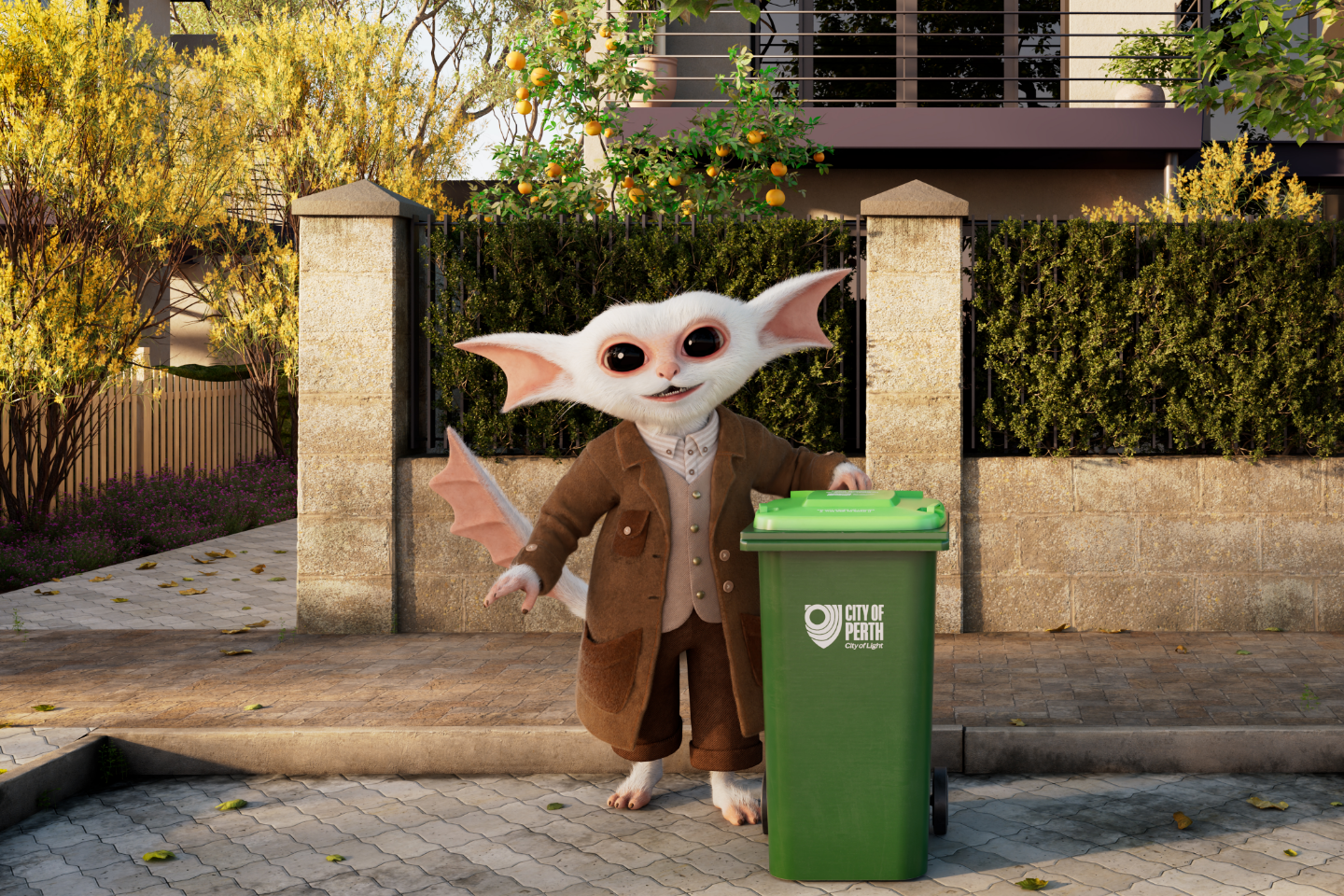
A handy tip from our Creature of Habit
Empty the kitchen caddy every 2-3 days and store it in the shade to help keep things clean and fresh.
FOGO resources
-
Why is the City introducing FOGO?
The City is the latest Western Australian local government to join the FOGO revolution to meet targets set out in the State Government’s Waste Avoidance and Resource Recovery Strategy 2030.
FOGO makes it easy for households to combine food scraps and garden waste and turn them into compost that enriches soil in parks and gardens - helping keep more material out of landfill.
It’s a tangible way for residents to reduce their carbon footprint and support a more sustainable City.
-
Where can I get compostable liners?
FOGO eligible residents will be delivered 2 rolls of compostable liners with their kitchen caddy. The City has made additional compostable liners available for residents that can be collected from the following locations:
- City of Perth Library, 573 Hay Street, Perth.
- The Concierge at Council House, 27 St Georges Tce, Perth.
- Container Refund Point, 8 Aberdeen Street, Northbridge.
In addition to these locations, our Waste Education team will always have liners available when they’re in the community. Alternatively, if you’re unable to attend one of these locations or events, please contact the City so we can accommodate your request.
-
I already compost, have a worm farm or use bokashi at home. Do I need a FOGO bin?
We encourage residents to continue using their home compost bin, bokashi system or worm farm. The FOGO bin can be used for items that you may prefer to keep out of your compost, such as bones, meat, seafood and excess garden waste.
If you use a bokashi system, the fermented material can be placed in your FOGO bin once the process is complete, particularly if you don’t have space to bury it.
-
Can I put compostable packaging or bioplastics in my FOGO bin?
No. Compostable packaging is not accepted in the City of Perth’s FOGO bins. This includes compostable coffee cups, wooden cutlery and food-soiled cardboard products.
Although these products are often marketed as compostable, many do not break down within the standard FOGO processing timeframe (approximately six weeks). Research has also identified concerns about chemicals such as PFAS in some compostable materials, which can affect the quality of the finished compost.
To ensure the best quality compost is produced and returned safely to WA soils, the City of Perth follows the latest scientific research, regulatory guidance and advice from the FOGO processing facility.
Food scraps and garden organics will always be accepted, just leave the packaging out.
-
Why doesn’t my new bin have any educational stickers?
In the past, the City placed up to three large stickers on each kerbside bin to help residents identify what goes in each bin and when to put them out for collection. Over time, these stickers can become damaged, fade or be difficult to update when service information changes.
To improve flexibility and reduce both costs and waste, the City will no longer apply stickers to new bins. All current waste and FOGO information is updated regularly on our website and provided in the FOGO guide.
If you would still like a FOGO-specific sticker for your bin or home, a limited supply will be available for collection at Council House. Alternatively, when you see our Waste Education team at community events, they will have FOGO stickers on hand.
-
How can I tell which kitchen caddy and/or new bin is mine?
Each new bin delivered to your property will have a small white sticker attached to the side of the bin (or on the back of the kitchen caddy). This sticker includes a barcode, your residential address (including unit number), and a description of the bin type (for example, 140L General Waste).
-
Why can’t my general waste bin be collected weekly?
The City’s three-bin FOGO service is supported by the State Government’s Better Bins Plus programme, which prioritises the weekly collection of food and garden organics to reduce waste sent to landfill and improve resource recovery. As food waste is placed in the FOGO bin, this becomes the primary weekly collection service.
To support this change, the City has redesigned its collection schedules and allocated resources to deliver weekly FOGO and fortnightly general waste and recycling collections. This service model will support significant progress towards State resource recovery targets while ensuring the efficient use of the City’s fleet and operational resources.
-
Can I get a larger or extra General Waste bin?Yes, an additional annual fee may apply for residents requesting a larger red bin (240L, collected fortnightly) or extra red bin (either 140L or 240L, collected fortnightly). Fees and charges for 2026/2027 will be confirmed in early July. If your household is struggling with the reduced general waste capacity, please contact the City for additional support.
-
Where is my FOGO material going?
Your FOGO material will be taken to the Western Metropolitan Regional Council’s Recycling Centre in Shenton Park. The FOGO material will then be transported up to a facility just north of Gingin, processed by GO Organics and made into an Australian-certified compost or soil conditioner.
-
Can I purchase the compost made from FOGO material?
Yes. City of Perth residents can purchase bagged FOGO compost at the West Metro Recycling Centre (Cnr Brockway Road and Lemnos Street, Shenton Park). The product is available for domestic use, subject to availability and sold at the standard advertised price.
The product is accredited and independently audited to meet Australian Standards for compost quality.
As the City continues to increase the volume of FOGO material collected and processed, we will explore additional opportunities to improve community access to the finished compost.
-
Why is the City removing my small 120L bins?
In 2016, the City of Perth incorporated a number of properties that were previously part of the City of Subiaco. At that time, many of these properties were serviced with 120L bins, whereas the standard residential kerbside bin size across the City of Perth is 240L.
To improve consistency and operational efficiency, the City is working to harmonise bin sizes across all properties. Maintaining multiple bin sizes increases the complexity and time associated with collection services. In line with the State Government’s FOGO requirements, residents will be offered either a 140L or 240L bin as part of this standardised system.
Please note, if you have retained your 120L bin, the City will not stock replacement parts for 120L bins. If one of your current bins becomes damaged in the future, it would be replaced with a 140L or 240L bin as appropriate. The collected 120L bins will be recycled and made into new kerbside bins.
-
Why is landfill becoming a less viable option for waste management
Landfill is becoming increasingly constrained and costly as a long term waste solution. It creates ongoing environmental risks, including methane emissions, potential groundwater contamination, and the permanent loss of land. At the same time, landfill costs are rising due to regulatory pressure and community expectations, while recycling and recovery rates remain low. Continued reliance on landfill exposes councils and communities to growing financial, environmental, and reputational risks without improving how waste is managed.
-
What are the benefits of FOGO compared to landfill
FOGO targets the largest recoverable part of household waste, diverting more than half of it away from landfill. This significantly reduces greenhouse gas emissions and extends landfill lifespan. FOGO also turns organic waste into compost, improving soil health and supporting a circular economy. In addition, recycling systems like FOGO create more local jobs than landfill and align with state policy directions, helping councils meet diversion targets while reducing long term costs and risks.
-
Are Short Term Rental Accommodation (STRA) properties included in the FOGO rollout?
The City recognises that there is an increasing number of properties operating as Short Term Rental Accommodation (STRA) and that these properties can have different waste management needs compared to standard residential households.
For the initial phase of the FOGO rollout, eligible STRA properties (including single dwelling properties included on the State Government’s STRA Register) have not been automatically included. This approach allows the City to work directly with these properties to ensure appropriate waste arrangements are in place.
The City will be engaging with STRA operators to support compliance with the City of Perth Waste Local Law, including requirements relating to bin provision, storage and responsible use of waste services.
How you can FOGO like a pro
Interested in FOGO for your apartment building or business?
The first stage of FOGO focuses on houses and smaller residential buildings with up to five units. If you live in a larger apartment building and would like your property considered in future FOGO expansion, please contact the City to register your interest.
If your business produces food waste and is looking for ways to reduce it, the City may also be able to support you through a FOGO collection service.