
Trees on private property in Crawley-Nedlands neighbourhood
Trees provide a range of benefits in an urban environment. They improve the liveability, landscape character, and climate resilience of the city. The presence of a healthy urban forest improves community health outcomes in increasingly urbanised environments, mitigates the effects of climate change, and provides enjoyable and engaging places.
Tree Retention on Private Property in Crawley-Nedlands Local Planning Policy
The City’s Tree Retention on Private Property in Crawley-Nedlands Local Planning Policy (policy) helps protect large trees on private property, known as regulated trees.
In some circumstances, development approval is required before a tree can be removed or damaged.
Planning requirements for regulated trees
Development approval is required before undertaking tree damaging activity to a regulated tree, including the removal of a regulated tree, unless it is exempt under the policy.
You are exempt from requiring development approval for:
- Trees that are listed on the State Weed Register.
- Routine pruning that meets the definition of maintenance pruning in the policy.
- Where the pruning or removal of a regulated tree is undertaken in accordance with an arborist report prepared by an arborist that meets the qualification requirements of the policy.
- Essential works as defined in the policy.
- Complying with a direction issued by the Department of Primary Industries and Regional Development (DPIRD).
-
Regulated tree
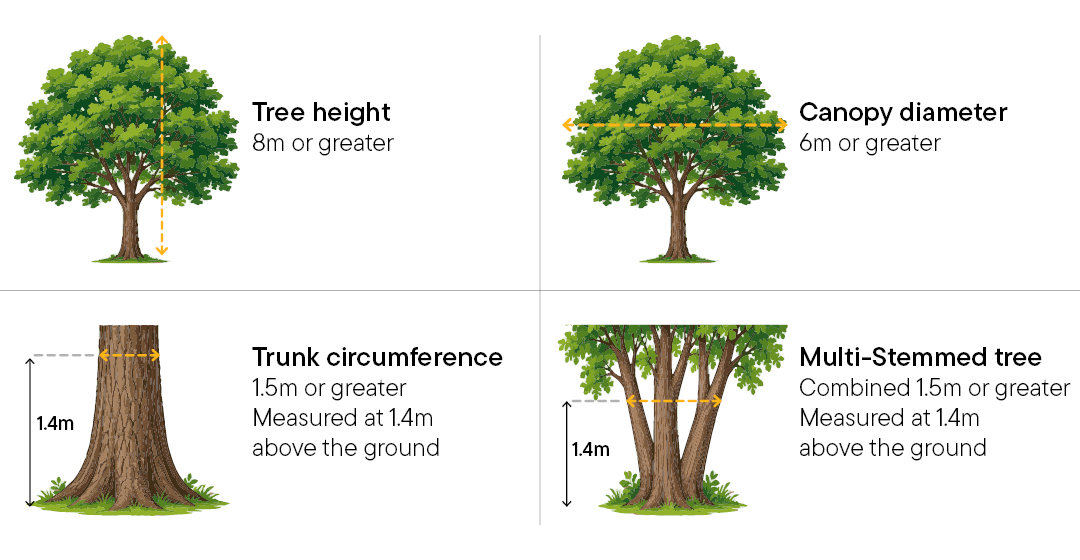
A regulated tree is a tree that meets at least one of the following size criteria:
- a minimum height of 8 metres
- a minimum average canopy diameter of 6 metres
- a minimum trunk circumference of 1.5 metres, measured 1.4 metres above ground level
- for a multi-trunk tree, the cumulative trunk circumference of 1.5 metres, measured 1.4 metres above ground level
-
Tree damaging activity
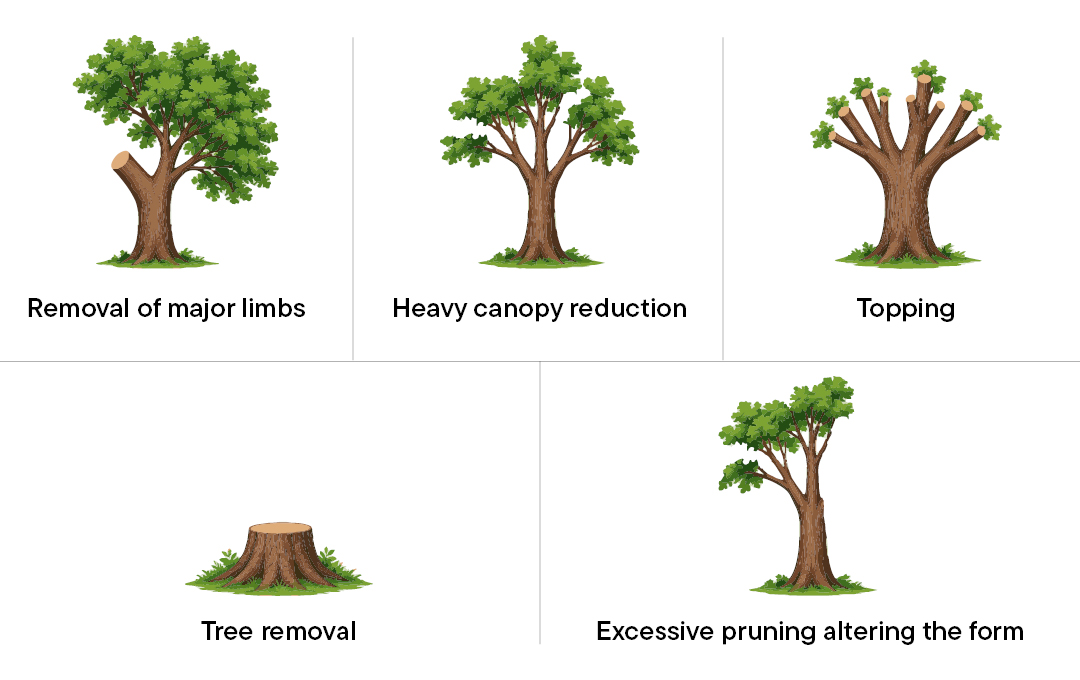
Tree damaging activity is:
- killing or removal of a tree,
- and activities or destruction that results in death or decline in health of a tree,
- cutting or severing significant branches, limbs, stems, trunk or roots, except where it meets the definition of maintenance pruning;
- poisoning of a tree,
- ringbarking, topping or lopping of a tree,
- excavation, stockpiling of fil or soil compacting in the Tree Protection Zone,
- any other damage to a tree that harms the health, stability, or long-term viability of a tree.
-
Maintenance pruning
Maintenance pruning is exempt from the requirement for development approval under the policy and is defined as pruning that does not harm the health, stability, or long-term viability of a tree, such as:
- removing dead or diseased wood
- activity done to a fruit tree for fruit production
- minor maintenance or thinning of the crown that does not adversely affect the health or general appearance of the tree or is to balance the tree
- pruning undertaken in accordance with the standard for Pruning of Amenity Trees ASNZ4373.
-
Exemptions from the requirement for development approval
Works to regulated trees that are exempt from the requirement for development approval include:
- Trees that are listed on the City’s Unwanted Species List or are Declared Weeds under the Biosecurity and Agriculture Management Act 2007
- Routine pruning that meets the definition of maintenance pruning.
- Where the pruning or removal of a regulated tree is undertaken in accordance with an arborist report and meets the minimum requirements of the policy.
- Tree damaging activity that meets the definition of Essential works in the policy.
- Tree damaging activity in accordance with a direction issued by the Department of Primary Industries and Regional Development (DPIRD).
Requirements for an Application for Development Approval
Before proposing tree damaging activity to a regulated tree, proponents should consider opportunities to:
- Avoid impacts on the tree through site planning, design changes or alternative construction methods.
- Minimise impacts where they cannot be completely avoided.
- Mitigate impacts through appropriate tree protection and management measures.
Applications are to include sufficient information to demonstrate the nature and extent of the proposed tree damaging activity and how the proposal addresses the requirements of the policy.
This includes:
- A description of the proposed tree damaging activity.
- Plans, photographs or other information identifying the regulated tree and proposed works.
- A written justification outlining why the works are required and any alternatives considered to retain the tree.
- An arborist report, where required by the policy.
- Any other supporting information necessary to demonstrate compliance with the policy.
For application requirements, fees and checklists, refer to the Minor Development Application Information Sheet and Development Approval Fee Schedule.
When assessing an application, the City will consider the proposal's impact on the regulated tree and whether the objectives of the policy can be achieved. This may include consideration of the tree's health and condition, its contribution to tree canopy and neighbourhood character, opportunities for retention, and any arboricultural advice provided.
Engaging an arborist
Trees are a valuable asset that contribute to the character, biodiversity and environmental quality of the City. Regular assessment and maintenance can help keep trees healthy, safe and structurally sound.
Engaging a suitably qualified arborist (minimum AQF Level 5) can provide independent expert advice, help identify potential issues before they become significant problems, and support informed decisions about tree management.
The key benefits of engaging a qualified arborist for a tree on your property are:
-
Correct pruning and maintenance
Improper pruning can permanently damage a tree, reduce its lifespan and increase the risk of branch or tree failure. Arborists can recommend and undertake pruning in accordance with industry standards to support the ongoing health and structure of trees.
-
Independent, expert advice
Every tree is different. An arborist can assess a tree's health, structure, life expectancy and suitability for its location, and provide advice tailored to the specific circumstances of your property.
-
Risk and safety management
Arborists can identify structural defects, disease, pest infestations or other conditions that may present a risk to people or property. Early intervention can reduce the likelihood of tree failure and help avoid emergency works.
-
Greater development certainty
Seeking arboricultural advice early in the design process can help identify opportunities to retain trees while accommodating development. Where retention is not feasible, an arborist can provide clear justification.
-
Protection of valuable trees
An arborist can help determine which trees are healthy and worthy of retention, and which may have limited longevity or declining condition. This allows effort and resources to be focused on preserving the most valuable trees.
Requirement for an arborist report
A qualified arborist can assess the health, condition and structural integrity of trees and provide advice on their management. An Arborist Report may be required in circumstances including:
-
Tree health or safety concerns
An Arborist Report is required to form part of an application for development approval when an application seeks approval to remove or undertake tree damaging activity to a regulated tree on the basis that the tree is unhealthy, structurally unsound or poses an unacceptable risk to persons or property. In the instance approval is sought on the basis of damage to property, a Structural Engineers report may also be required to identify the damage as structural and determine the source of damage and appropriate solution.
-
Significant pruning
If proposed pruning extends beyond maintenance pruning, advice from a suitably qualified arborist should be obtained before proceeding. Incorrect pruning may constitute tree damaging activity and can adversely affect the health, stability and longevity of a tree.
In accordance with Table 2 in the policy, pruning work that is undertaken by an arborist and is in accordance with the recommendations in a tree condition assessment (type of arborist report) is exempt from the requirement for development approval.
-
Development applications
An Arborist Report may be required to assess the impacts of development, excavation, service installation or other works on regulated trees and to identify measures to avoid, minimise or mitigate impacts.
Finding a qualified arborist
The Arboricultural Association of Western Australia maintains a directory of qualified arborists: Find an Arborist | ArbWest
Neighbouring trees and overhanging branches
Routine pruning of overhanging branches that doesn’t harm the health of the tree may be exempt under the policy. Significant pruning, root damage or work likely to cause decline or death may require an application for development approval. The City encourages landowners to always discuss upcoming pruning and concerns with their neighbour first before undertaking any pruning.
Frequently asked questions
-
Does the policy apply to every tree?
No. The policy applies to trees that meet the definition of a regulated tree and are located on private property within the policy area and are not a weed species.
-
Can a regulated tree be removed to make way for development?
Potentially, subject to receiving development approval.
When considering tree removal, the city has an avoid, minimise and mitigate framework.
The policy seeks to retain regulated trees and encourage development to be designed around existing trees wherever practicable.
Applications for the removal of regulated trees are assessed using an avoid, minimise and mitigate approach. Proponents must demonstrate that reasonable design alternatives have been considered and that retaining the tree would unreasonably compromise the intended development outcomes for the site.
Accompanying information may include a development feasibility and development constraints analysis, site layout options, built form scenario modelling, massing diagrams, accommodation schedules and/or yield analysis and calculations.
Refer to the policy for further information.
-
Can I remove a tree that is damaging my property?
Potentially, subject to receiving development approval.
The City may support an application for tree damaging activity where sufficient evidence demonstrates that the tree is causing significant structural, safety or infrastructure impacts. Applications are assessed on their individual merits and should be supported by relevant technical information:
- An Arborist Report prepared by a suitably qualified arborist confirming whether the tree is contributing to the damage and identifying any management options, including works to retain the tree where feasible.
- A Structural Engineer's Report confirming the nature and extent of the damage, identifying its cause, and assessing whether alternative solutions are available.
The submission of an Arborist Report or Engineer's Report does not guarantee approval. The City will consider all relevant information in accordance with the policy and the applicable planning framework.
-
What if a regulated tree is causing leaf litter, shading or blocked views?
Trees naturally produce leaf litter, shade and seasonal debris. These matters are not sufficient justification for tree removal. Applications are assessed against the provisions of the policy and supporting evidence provided.
-
What happens if a regulated tree is damaged or removed without approval?
Reports of possible non-compliance can be submitted to the City’s Development Compliance Department in writing and should include sufficient information, such as the property address, description of activity or works, and any evidence you may have to allow the matter to be assessed. The City will review the information provided and determine any further investigation or action.
If you are concerned that unauthorised works are currently being undertaken to a regulated tree and require urgent assistance, the City's Development Approvals unit can be contacted at (08) 9461 3366 or [email protected].
-
If my plans comply with the Residential Design Codes but I have to remove a regulated tree, do I need an approval?
Yes. The removal of a regulated tree requires an application for development approval unless otherwise exempt in Clause 4.0 in the policy.
-
How can I confirm if the tree on my property is an unwanted species or weed species?
If you believe your tree may be on the State Weed Register you can submit photographs to the City for assistance with identification. Clear photographs of the whole tree, leaves, bark, flowers and fruit (where available) will assist with accurate identification.
Downloads
- Tree Retention on Private Property in Crawley-Nedlands Local Planning Policy485.63 KB | PDF Document